"Intel 18A is now ready." So proclaims a new landing page on Intel's website for the company's all-important new 18A chip production node. But what does it mean for the PC?
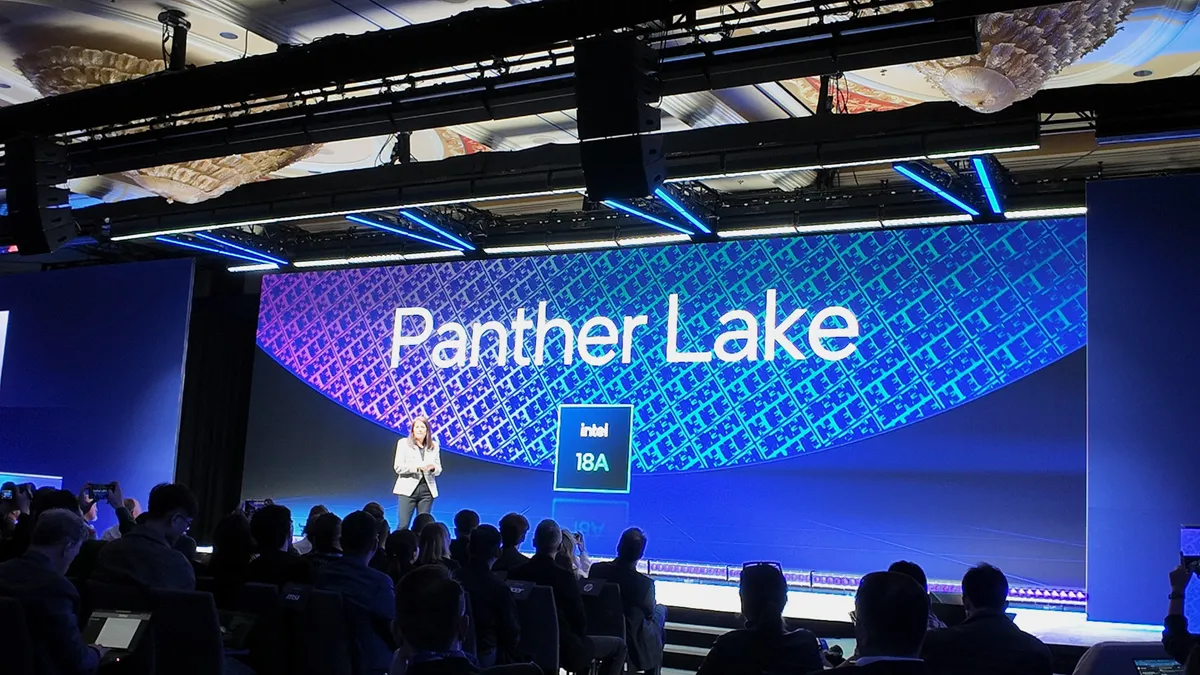
We already knew that Intel's next laptop chip, Panther Lake, is due to be made, at least in part, on the new 18A node. That's supposed to be going into volume production later this year, though we're not expecting 18A-powered laptops until early 2026.
Still, if 18A is as good as Intel is cracking it up to be, whether it's complete "ready" now or early next year probably doesn't matter. It'll be a great node that will not only enable some really competitive chips for Intel, but surely have customers queuing up to have their chips manufactured by the only real alternative to Taiwanese mega-foundry TSMC.
Among other advantages and refinements of the 18A node, Intel is making the following claims:
- Up to 15% better performance per watt and 30% better chip density vs. the Intel 3 process node.
- The earliest available sub-2nm advanced node manufactured in North America, offering a resilient supply alternative for customers.
- Industry-first PowerVia backside-power delivery technology, improving density and cell utilization by 5 to 10 percent and reducing resistive power delivery droop, resulting in up to 4 percent ISO-power performance improvement and greatly reduced inherent resistance (IR) drop vs. front-side power designs.
- RibbonFET gate-all-around (GAA) transistor technology, enabling precise control of electrical current. RibbonFET allows further miniaturization of chip components while reducing power leakage, a critical concern for increasingly-dense chips.
If 18A really does deliver on all that, it'll certainly be highly competitive with anything TSMC has to offer. Broadly, Intel 18A is thought to be less dense in terms of logic gates than TSMC's upcoming N2 node and more akin by that metric to the N3 node that TSMC has been banging out for about 18 months now.
However, another key measure is SRAM density. SRAM cells are used to provide critical on-chip cache memory. It was thought until recently that 18A was at best on par with TSMC N3 for SRAM density. However, it's recently emerged that Intel 18A in fact offers pretty much exactly the same claimed SRAM density as TSMC joy rummy N2.
Meanwhile, TSMC is not planning to include backside power delivery until its own A16 node. Long story short, backside power relocates the power interconnects from the top of the chip to the underside of the silicon layer, thereby separating it from signal interconnects. This reduces interference and shortens the distance power has to travel, which improves efficiency and performance.
As above, Intel 18A has backside power, which could be a big advantage over TSMC N2. Ultimately, we'll have to wait and see. But we absolutely have our fingers and toes crossed that 18A works out. The alternative could be very bad for Intel. Gelsinger did say, after all, that he had "bet the whole company on 18A."
And the way the chip industry is going these days, "very bad for Intel" could quickly turn into even more expensive chips for the PC.
We need as much competition in the industry as we can get. So, we generally agree with the sentiments an Intel engineer posted and then removed from Linkedin earlier this week, which basically boil down to not giving up on Intel just as it is about to turn things around with 18A.